

Introduction
Does your IT department still swim in a sea of manual tickets and slow response times? The Year Is 2026 —Things Have Changed in Tech Gone are the days of manual triage and reactive fixes. Gone are the days of simple ICTIL ticket tracking, today intelligent IT Service Management is about using machine mind to predict and prevent technological problems before they reach end user.
This expansive guide dives into the best IT Service Management platforms in 2026 employing Generative AI and Predictive Automation to amplify business operations. If you want to make your workflow a smart self-healing ecosystem, you are in the right time and place.
Deeper Insights: The Foundation of AI-Powered ITSM by 2026
By 2026, the common misconception of AI as just a chatbot in a corner window has beenfinally debunked. In actuality, AI is the “Silent Engineer” in the contemporary environment of IT Service Management. Monitor all micro-interation across your network, no manual effort required so systems will be self-aware. 2023 has transformed the way ITSM works at a global level through three particular pillars.
Read about Chatbot
Using Generative AI (GenAI) for ticket summary automation
Ticket handling has been turned upside down by generative AI. In the past, IT agents spent hours scouring long email threads or historical logs to learn about a problem. Today, IT Service Management platforms have integrated GenAI that generates these brief summaries in seconds. This saves time for the agent, and dramatically decreases the “Mean Time to Resolution” (MTTR) as the technician can understand the crux issue within one paragraph.
Predictive Analytics – Early Warning Signals to Avoid Downtime
The enemy of every modern business is downtime. As of 2026, Predictive Analytics has become a basic feature where the Ai can look at historical data and real-time patterns to find anomalies. It issues warnings several hours ahead of a server failure or software failure. This transition in IT Service Management keeps IT teams from having to follow a “Reactive” model but rather brings them into a “Proactive” stance – preventing issues before they arise.
Natural Language Processing (NLP) in Multilingual Global Support
Language was a significant barrier for multinational corporations. Modern NLP goes beyond translation; it understands sentiment and intent. AI-powered IT Service Management tools instantly understand whether a user has filed a complaint in Sindhi, Urdu or Spanish; translate the request for the agent and respond back to user in user’s native tongue. This means that in global support desks, work can be done 24/7 with complete linguistic accuracy.
AIOps — How AI is Transforming the IT Operations
2026 has helped in putting a line that most of the people are drawing similarly between AI and IT Service Management. While ITSM is the “front-of-house” that engages users, AIOps (Artificial Intelligence for IT Operations), is the “engine room” running in the background. It leverages Big Data and Machine Learning to comb through thousands of system logs, metrics and network signals every single second—performing the impossible task for humans.
Incident Intelligence: Shift from Reactive to Proactive
The single biggest issue for IT teams has always been “Alert Fatigue” — receiving thousands of little alerts that mask the one true issue. In 2026, however, AIOps addresses this challenge through Intelligent Noise Reduction. It picks only the potential alerts and filters all the “background noise”, alerting only when a non— normal anomaly is found on single or multiple nodes to IT Service Management team. This gives teams the ability to cease “firefighting” and begin preventing problems before they impact a single user.
Self-Repairing Systems — Enter Autonomous Remediation
We are now in the “Self-Healing Data Center” age. Autonomous Remediation means the AI does not only tell you there is a problem, it solves it.
For instance, if a server is reaching 95% memory usage, the AIOps engine can immediately execute a clean-up script and/or spin up a temporary cloud instance to balance the load. When a technician actually looks at the dashboard, AI has already solved the incident and updated an “Auto-Remediation” report in IT SM system as success.
Click here about Autonomous
Real-Time Root Cause Analysis (RCA)
Traditionally, when a critical system failed, experts would conduct “Root Cause Analysis” by spending hours or days to discover what went wrong. This is done within milliseconds in 2026 under the AIOps domain. By cross-referencing data from the entire infrastructure — application layer down through the physical hardware — it instantly identifies where the failure point occurred. This visibility is fundamental to modern IT Service Management and lowers the Mean Time to Resolution (MTTR) by 90% or more.
Comparison table of the top 10 ITSM software (Ranked till 2026)
Coming to 2026, your IT department is only as efficient as its AI-integrated IT Service Management tools. Here are the top 10 platforms that deliver everything from predictive maintenance through to automated ticket resolution this year.
Gartner Peer Insights — The Voice of the Customer in 2026
In 2026, user feedback has skewed heavily toward the “Experience Economy.” Based on recent Gartner Peer Insights the most effective IT Service Management implementations are those where AI is perceived as being invisible whilst also being helpful.
The big buzz is about GenAI-powered auto-replies, which users claim have reduced their “wait time” by nearly 80%. ServiceNow users constantly praise the power of the “Now Assist” AI, and Jira users rave about the Atlassian Intelligence feature for linking developer bugs directly to IT support tickets. Yet some users are still warning the cost of premium AI features in enterprise-level tools is high.
Cloud-Native vs. On-Premise vs. Cloud: Which is Safer for AI ITSM?
The 2026 question of how to deploy, comes down to a matter of data sovereignty and speed of AI processing.
- Cloud-Native ITSM: This is the 2026 gold standard. Thus, cloud-native IT Service Management platforms that deploy modern AI can retrain their learning models while they are in the wild. Now, with “Zero Trust” security protocols in place, they are regarded as more secure ffor use in remote and hybrid work settings.
- On-Premise ITSM: Once the purview of government agencies and tier-one banks that wanted to keep their data “inside the walls,” these systems are mining dust as AI moves up a gear. In fact, using a local AI engine requires expensive GPU hardware and is usually more cost-prohibitive than cloud-based solutions.
The Ruling: For the vast majority of organizations, Cloud-Native will lead IT Service Management in 2026 because it allows to quickly scale AI automation without having to make enormous investments in internal hardware.

How Does AI Automation Cut IT Costs?
If you are an owner or stakeholder of your business in the year 2026, realizing that having AI-driven IT Service Management is not only a new technical upgrade but also a deciding financial factor. AI: Bottom Line–to–Bottom Line Organizations are entering a revolution where the bottom line of their organizations is being transformed by AI taking over high-volume, low-value, repetitive tasks that have consumed (historically) 50%-70% of traditional IT budgets. So, the top objective is to ensure maximum Return On Investment (ROI) by converting IT department from cost center into efficiency engine
Lowering “Cost Per Ticket” Using Intelligent Self-Service
This is a crucial metric for any business—the Cost Per Ticket. Traditionally, a Level 1 support ticket (an issue like password reset or software permissions request) might cost a company $15 to $25 in terms of time spent by an agent.
Generative AI is the driving force behind “Smart Self-Service” portals used by modern IT Service Management platforms in 2026. Incidents Avoided As These Portals Solve 75% of common issues within their lifetime through a natural language conversation. This “Zero-Touch” solution basically drives the cost of those tickets to near-zero. Handling thousands of tickets without the intervention of a human allows companies to save hundreds of thousands in operational expenditure annually.
Effects on Employee Performance and Retention
The ROI of automated IT Service Management goes beyond savings; it’s about revenue generation and improved productivity:
- Eliminating Downtime: If an employee has to wait four hours on a software fix, that’s four hours of lost revenue. From automation of AI which offers instant fixes to keep the workforce in motion, AI is on board.
- Minimising “Context Switching”: AI manages the interruptions, freeing up your talented IT personnel for high-value projects such as cybersecurity & scaling infrastructure.
- Employee Retention: The big hidden cost is IT burnout. Enabling IT staff with higher job satisfactionReducing the “boring”, repetitive pieces of their work by automating it In 2026, organizations with IT Service Management augmented by AI tools report a 25% higher retention rate of technical talent, substantially reducing costs associated with recruitment and onboarding processes.

ACTING GUIDE: Moving Toward an AI ITSM Ecosystem
Making the switch to an AI-powered IT Service Management platform is not as easy as “plugging and playing. You mean, a strategic onboarding of the AI so it knows your business context and brings value from day one. The most successful organizations in 2026 embrace a disciplined three-phase approach to service desk modernization that minimizes potential interruptions to day-to-day business.
Step 1: Data Cleaning – Getting Your Knowledge Base Ready for AI
The best AI is only as good as the data it consumes. You need to do “Knowledge Hygiene” before migrating to a new IT Service Management tool.
- Audit the articles on your site: Outdated troubleshooting guides and redundantly lengthy FAQs are up only to pull down your ranking.
- Structure the Data: AI models (LLMs) respond best to clear, well-structured data.
If you put “garbage” data into the echo-chamber of AI, it spits out incorrect or “hallucinated” responses for your employees. It makes sure that the AI auto-resolving rate is very high and right.
Step 2: Selecting “Out-of-the-Box” AI vs. Custom Models
2026: Organisations face an urgent decision around the “brain” of their IT Service Management system:
- Out-of-the-Box (OOTB) AI: Pre-trained models available via solutions like Freshservice or Jira Ideal for companies looking to start with out-of-the-box IT workflows.
- Custom AI Models: Large enterprises have specialized needs when it comes to security, or perhaps they rely on unique industry jargon (See AiOC from ServiceNow for example) and these customers can be better served by a custom-trained model.
The right model for you will depend on your budget, the complexity of IT environments and your internal data science capability.
Step 3 – Preparing Your IT Staff for the AI Co-Pilot Era
Job of IT technician is evolving and changing. They’re not just “ticket solvers” anymore; they are now “AI Orchestrators.”
- Prompt Engineering: Educate staff on how they should communicate with AI to get better resolutions.
- Supervisory Roles: Rather than fixing every laptop issue manually, technicians will spend more time reviewing the AI-generated fixes to ensure they meet a minimum quality threshold.
The secret to a successful IT Service Management transition is training your staff not to view AI as a replacement, but rather as the “Co-Pilot” in their journey.
The Challenges of AI Automation from an Ethical Perspective
Although AI offers numerous advantages to IT Service Management, the swift integration of such technologies in 2026 has created challenges as well. Shadow AI (unauthorized use of tools by employees), according to many reports, is just one example that could lead to huge losses, while challenges such as algorithmic bias and other issues have the potential for serious implications — organizations are working hard to navigate these scenarios diligently in an effort to build digital trust and maintain operational integrity.
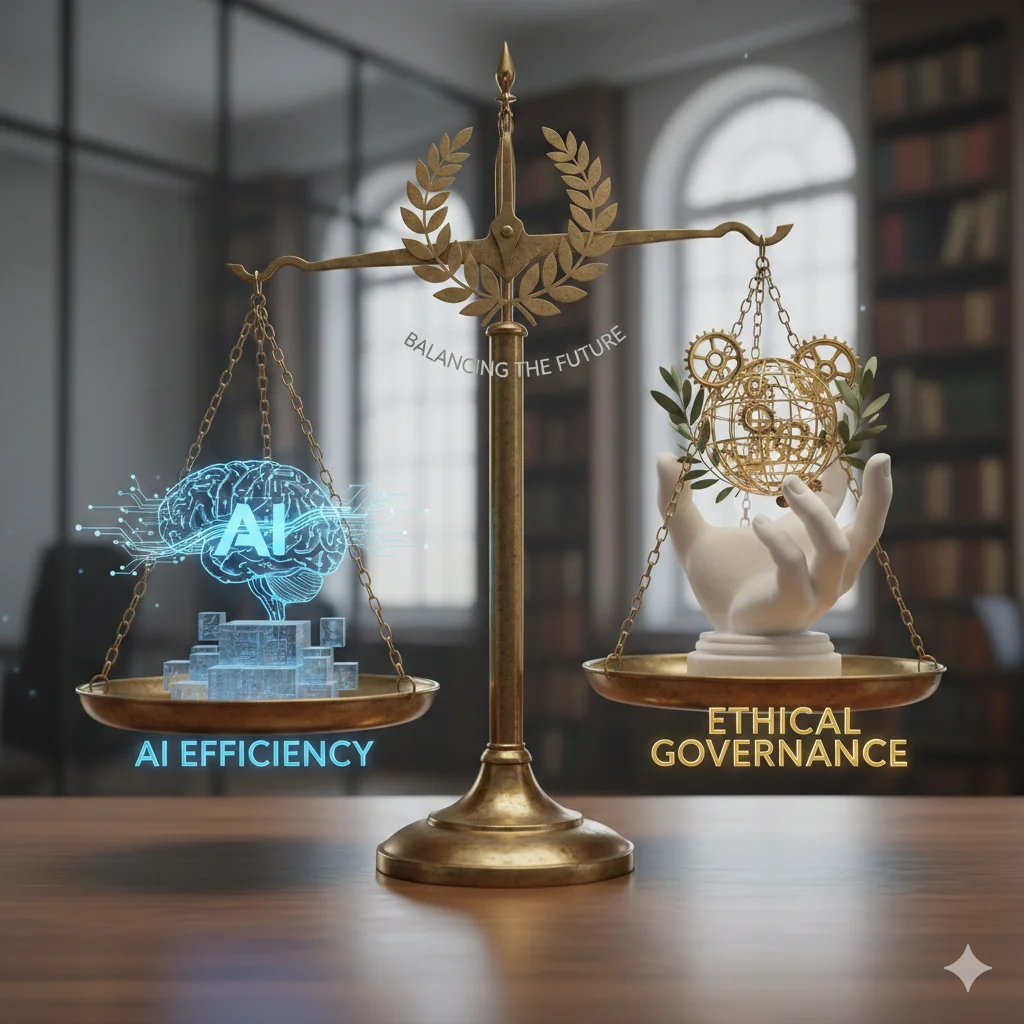
Exploring the Ethics of Data Usage in AI Models
Data privacy is still the number one fear this year for 57% of IT professionals. Understanding the terms of how IT Service Management tools use LLMs, there is a potential for “Data Leakage” where personal company information like credentials or private financial data may be unintentionally absorbed into the model’s training set.
In 2026, the safest route might be towards Private AI or Domain- Specific Language Models (DSLMs). These models make sure that your own data stays within your organization’s safe confines and is never used to train public algorithms. Governments have new legal frameworks in place for accountability, such as the EU AI Act and regional privacy laws to comply withNumidia compliance; ITSM strategy will now need to take these into consideration or face huge legal and monetary penalties.
The Human Factor — When to Transition From AI to a Live Agent
The greatest risk in 2026 is “Blind Trust.” If, say, an AI agent tries to solve a critical server problem based on stale data or “hallucinations,” it can cause service outages that cost millions.
An adult IT Service Management ecosystem requires explicit Human-in-the-Loop (HITL) models:
- AAMVA recommends more sensitive behaviour, including: If the AI detects that a user is peculiarly frustrated or angry, it must immediately escalate to human.
- Complexity Thresholds: Human authorization is required for any requests where something is being unlocked that involves permissions around security or procurement of a high-cost item.
- The “Kill Switch”: IT teams should be able to immediately override AI-automated changes (agent-induced drift is the term for when AI starts making small adjustments without involved human logic, which eventually grows into a bigger issue).
AI is a phenomenal co-pilot, it should never be the only pilot. By keeping things human-centric, your IT Service Management will empathetised and accurate.
Future of AI Automation – What Comes Next?
The hype around AI will peak by 2027 and we will enter the Hyper-Autonomous era of IT. If 2026 was the year of AI as co-pilot, over the coming four years we will see AI leading strategy and execution. IT Service Management will have a transition from you so-called this “issue resolution” phase into the new world of complete delivery with a JEDI enterprise.
Impossible to Triage? Enter Autonomous Service Desks
The “End of Triage” will probably happen between 2027 and 2029. Now you still need some manual sorting (triaging) to route tickets with AI to the right teams. But the next generation of IT Service Management will offer fully autonomic desks.
These systems will leverage Agentic AI — AI agents that can reason, plan and carry out complex workflows across multiple software platforms. If, for example, a regional office loses connectivity, the autonomous desk will check if there is an upstream ISP issue, will reroute traffic through a backup satellite link and update the internal status page—all without a human clicking any buttons. AI starts managing the complete lifecycle of an incident, and manual triage becomes history.
Integration with Quantum Computing for Immediate Problem Solving
2030 years of Quantum Computing in IT Service Management ecosystem solves the “Complexity Wall” Classical, enterprise AI may not be able to make sense of the data fast enough as trillions of IoT sensors and edge devices multiply infinitely across networks.
Quantum-enhanced ITSM will provide:
- Instant Optimization: Real time calculation of the most efficient data paths across global networks, removing latency.
- The Ultimate Prediction: The ability to simulate millions of “what-if” scenarios using quantum algorithms, letting IT leaders understand the effects of a particular system change before they run it.
- Unsolved Problem: Root Cause Analysis of systemic failures across monolithic microservices in enormous multi-cloud topology that would take days to unwind with current machine learning.
Future of IT Service Management is not about being faster but rather “Pre-cognitive” — addressing the future before it ever breaks the present.
FAQs Related To AI ITSM Tools
Is AI going to eventually replace human IT support agents?
No. While AI is being implemented for Level 1 (repetitive) stuff like password resets and basic troubleshooting, the requirements of human expertise are actually on the rise for Level 2 and Level 3 support. Humans are needed for complicated structure, ethical decision and governing the AI systems themselves. AI is a productivity multiplier, not a complete replacement.
How long does it take to realize ROI from AI ITSM?
By 2026, the majority of mid-to-large enterprises are experiencing a clear ROI in less than six to twelve months. The upfront costs in software licensing and data cleaning are regained many fold through the quick decline of “Cost Per Ticket,” which results in regaining lost hours due to low productivity for businesses based on service.
What’s the best IT Service Management tool for a small business?
Freshservice and Jira Service Management are the top picks for smaller teams. They don’t need a team of data scientists setup instead offer AI out of the box. They are scalable, so you can start small with basic automation and add sophisticated AI capabilities as your company grows.
Is my company data secured while using Generative AI in ITSM?
Your deployment model will determine your data security. Your data is very secure if you are using “Private AI” instances or ZTA-compliant tools. Only work for an IT Service Management provider that promises not to train its public AI on your internal data.
What is the biggest mistake organizations make proceeding with AI ITSM?
The biggest blunder is “Garbage In, Garbage Out”. Several organizations attempt the automation of their workflow systems but forgot to cleanse their knowledge base. If your documentation is outdated or messy, the AI will give wrong answers resulting in a frustrated user and an implementation gone bad.
Conclusion
The IT Service Management landscape in 2026 is less about managing tickets and more about managing intelligence. The right platform and a financially savvy mindset are all it takes to make AIOps the powerhouse behind IT innovation. Those who can complement the speed of artificial intelligence with human strategic oversight will lead us into a new era.